Episode Summary:
Episode 21 begins with Kyle and Adam continuing their imaginary mission to Mars, discussing reusable rockets, Elon Musk’s vertical landings, and whether hitching a ride in a Tesla is still on the table. From there, they unpack The Martian, Andy Weir’s writing, and what it would actually take to survive off-world — quickly realising that potatoes may be humanity’s greatest spacefaring asset.
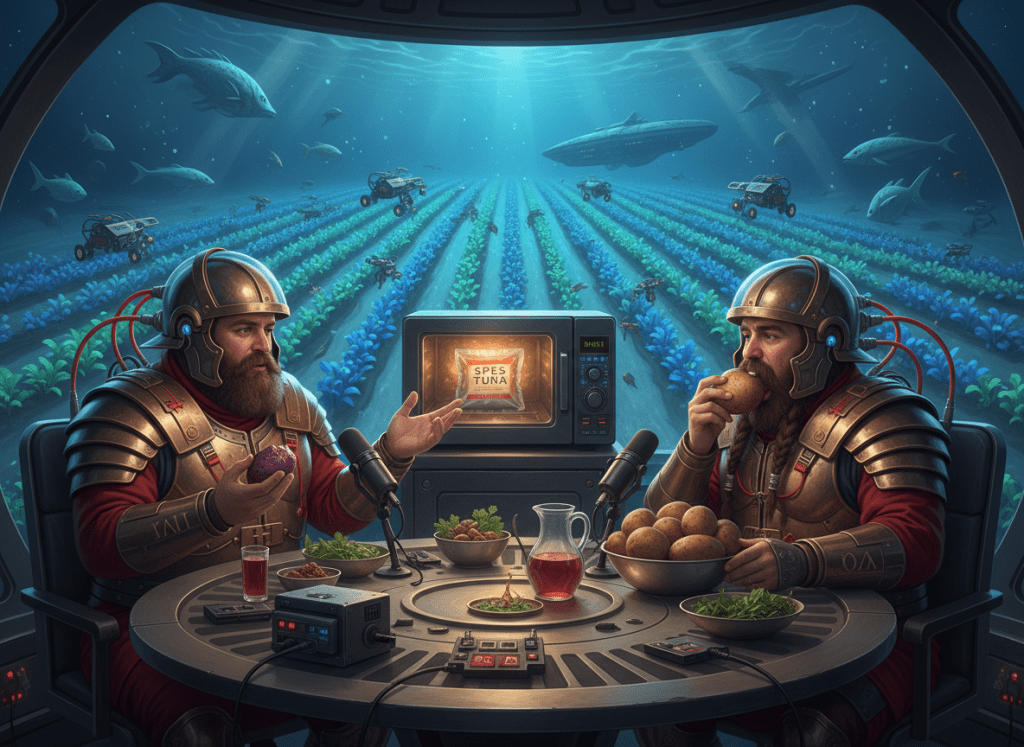
Food becomes the unexpected core of the episode. They dive into growing potatoes, childhood memories of cress in eggshells, and the long-standing debate over egg and cress sandwiches (with strong opinions). This spirals into office food etiquette, banned microwave items, tuna crimes, fishy microwaves, and the irreversible damage caused by burnt popcorn.
From lunchroom warfare, the conversation pivots into food security, waste, and agriculture — touching on the Irish potato famine, crop diversity, seed vaults, genetically modified food, and the uncomfortable reality of how much edible food ends up in the bin. Composting, worms, recycling myths, pizza boxes, and the odd logic of modern waste systems all come under scrutiny.
The episode then zooms back out to planetary exploration, questioning whether Mars is really the best next step — or if humanity should explore Earth’s oceans first. Deep-sea creatures, underwater domes, BioShock, Star Wars’ Gungan cities, and Brian Blessed somehow all collide in a debate about which hostile environment is worse: space or the deep sea.
The episode closes closer to home, reflecting on travel, unexplored parts of the UK, regional accents, Scotland’s landscapes, and a gentle tease toward Roman and Greek history, setting the stage for the next chapter of the Continuum.
A true Continuum episode: Mars → potatoes → microwaves → compost → the ocean → the Romans.
Podcast Links
Episode Transcription
The transcription for this episode is AI generated and may require further review
All right. Welcome along to the continuing podcast. My name is Adam. In the other corner, as always, is Kyle. How’s it going, Kyle? Right. Yeah. Good thing. Says it’s ready for the. Ready for the journey. For the journey to Mars, which is where you’re going to take us off. All right. Yeah. I guess we got to figure out how to get there.
And, I’m thinking we we roped in our old friend Ellen and get him to shoot us up there in a Tesla.
Well, you know, he’s been developing these rockets to to go there now. And one of the main.
Ways that he’s trying to get this rocket to work is also to obviously shoot shoot up, but also come back and land, because that was the whole reason for the shuttle program, wasn’t it was it was becoming too expensive just to send rockets up to the moon at that point. If that ever happened and then the they would basically lose the entire vehicle.
READ MORE
But now with the shuttle program to get it up, they could bring the aircraft back down and then just attach it to another rockets and shoot it up. And I think Elon’s whole idea is to use the same rockets that’s going to shoot up and then kind of land back down on let’s kind of land back down. It’s just really weird to see when you watch it.
It’s like a reverse acceleration kind of thing. Right. So it basically lowers itself. Yeah. Down so that it can be reused. So it can be relaunched. Yeah. You know, I think, I think I have seen that now that I think about it. But go on. So we’re going to need one of those. Yeah. I’m not exactly sure.
What. Have you seen The Martian? I’m. I have, I have an I actually, I know I, listen to a lot of books. However, that was, one book I actually read. That was a book I didn’t know that was a book. Yeah. I think it’s. I think the author’s name was Andy Weir. I want to say, it’s quite interesting.
He did. He did The Martian and he did another one, about a, oh, about a person who basically does. I think it was like mail delivery, but on the moon, where there’s like a structure on the moon. Right. The humans kind of living on there as well. So he’s, he’s proper into the whole, like he was living anywhere but Earth.
Yeah. Exactly. Scenario. Yeah. I didn’t know. I didn’t know it was a book. Is it is as good as the film, or is the film as good as the book? Again, I think I think the film did very well to, to kind of stand in as the book does. I think the book, again, is a little bit more content, a little bit more put extra information that you’re probably missing.
But I think it did a really good job. I thoroughly enjoyed the movie. And I think a lot of people that didn’t I. Yes, but they did give me some ideas as well, if I can say this, when when we’ve spoken about this project, what we’re going to do is we got to sort out food. Yeah.
It is, it is, is is potato is really one of those things where you can cut it up in smaller pieces and it can grow from there. You just need it. Well, yeah. But you don’t need to even cut it up. Yeah. I’ve grown. I grow potatoes pretty much every year. Potatoes just. Have you ever like to where do you put your potatoes?
When you go through, you chop it in the trolley. Okay? When you get home, once you’ve got the potatoes, where do you put them? Do you put them in the fridge or do you put them in the cupboard? I put them in a cupboard. Okay. So after if you don’t get through them for a couple of weeks, do you get the little chips on them.
Yeah. Yeah. So each one of those I think becomes another potato. But that’s a process that’s already a place. I’m going to have to try this, but do you mean it’s going to start growing in like a cluster or. Yeah. Yeah, it grows like it shoots out and grow, I think. In fact, I think the chips grow into, like, roots sort of thing.
And then more potatoes grow off those roots. You know, I’ve dug them up and now that I’m thinking about it, they come like basically off a big string. That one potato, like, turns to mush, but it sort of feeds the rest of the potatoes. It’s really quite alien. All right. Okay. It’s like they’re the easiest thing to grow in the world.
Yeah, because that’s out there so easy. Perfect crested. Did you grow cress at school? Fast food. Did you know that? That was one of the wacky things that I remember doing at school. I think you grow Chris in an egg shell. One egg shell. All right. No, it’s just what it was. You cut an egg shell or, you know, break an egg shelter and crack it so that it’s nice.
Nice half to the, you know, you get the bottom half of this soil in a couple of cress seeds. Off it goes. Sounds pretty wasteful how I think I think actually, because, you know, people compost egg shells. I compost egg shells. Yeah. So imagine it actually gives a little bit of nutrients. That’s perfect. That kind of makes sense.
But yeah. Why and how much does this Chris Carrot, is he talking within a couple of weeks. It’s kind of overgrown. All. I mean, this this is like a we’re talking something I did coming up to 30 years ago. What do you even use for salads? Egg, Chris. Egg. Chris. That’s why you grow in the shell. Because it goes so well with egg.
Right. So that’s not really something that I actually agree on because I think egg Chris sandwich is a grim. No, I mean, I do, I do enjoy a good egg, Mary’s sandwich. But again, you’ve got to you’ve got to pick your environment. Yeah. Actually talking about that. No, I have had, egg mayonnaise and Chris sandwiches do bothers me a from the little vans you used to combine.
Will not drop food off, but you could buy from that. That actually, you know, go along those lines. You’re saying it’s one of the. I remember back when we used to work together. I can tell you who, but people bought in. I probably wish you to be honest. Yeah. I was putting in an egg cress sandwiches or egg sandwiches.
So these sort of things should be banned. In fact, I’ve, I distinctly remember telling you that you are allowed to put fish in the microwave, but you continued to do so. No, no, no, I didn’t put fish in the microwave. I did bring fish to work. So it’s an assault on the senses, and no one should be allowed to do that.
This is where I work now. Everyone eats Tudor. It drives me nuts. Yes. It stinks. Yeah, the place that I work now, I work for myself. So I need as much as I like. I’m having a big tuna sammies every day. Oh, God. Yeah. So on the sense, there’s obviously people. People that take I mean, you’re in a different, situation now where you are working on your own, so that’s fine.
I’ll give you a pass for that. But but is it because you don’t? There should be no need to bans. No. I actually think even if I did hear, I think it’s too aggressive. No, I do, but the smell is too, you know, if people put like salmon or something in the microwave and then I put something in afterwards, my food will start tasting like salmon.
Yeah. Okay. Yeah. I think you have said before, you’re not a big fan of fish, though. I, I’m not a big fan of fish. So would you but you I’m saying is you’re saying is it’s not right that you put the salmon in the microwave when you know goddamn well other people are kind be using that microwave after the.
Okay. Yeah. Okay. So I guess we. There should be rules. Come on. Yeah. But again, we’re living in this world now. It’s. You can’t you can’t please everybody can, you know? So you know, I want to say not me. I want to say maybe you’ve got to have two microwaves and you to have a fishy microwave. You know what?
I was just thinking that I was actually thinking there’s the there’s only one real way around this, and it’s having one microwave for fish, one microwave for a curries, one microwave for everything else. Yeah, that’s a reasonable one. Yeah, I don’t mind. I remember going to, my, my wife’s nan’s house and got a Korean warmed it up in the microwave, and, she, she kind of.
She was cursing for days. But you know what? The other one that stinks is popcorn. Even the microwave popcorn, which is, you burn that stuff and you’re in trouble. Yeah, you’ve got to cook that stuff perfectly. Yeah, because it’s the microwave stuff. It’s just impossible to get, really, and cook it all. All the way through. You know, you’re always going to get these little kernels left at the end.
I had it once, so we had microwaveable popcorn on the cobs. Okay. Just like dried it. There were popcorn basically still on the cob. And you put them in these little bags, tied them off and put them in the microwave. Pop, pop, pop. Off they went. Now, one of them I took out and like, half the cob was still unpopped.
And I was like, that’s no good. Put it back in probably ten 20s ruined the microwave. Obviously it burnt it like burnt all the ones that were popped. It burned those. And then the microwave. You we couldn’t get rid of that smell. I’m pretty sure we ended up in in the microwave, you know, just for a little bit.
Of course. Yeah, yeah, I think for 10s, microwave popcorn is, really convenient. However, I think if you’re going to do it, you have to do it on the stove with the pots or whatever else I do for them. That’s kind of the best way to the best way to do one of those ones that’s got a little lid on.
Yeah, it’s what I do. It. What does that that the you can get them in the actual bags that come with like they’re like foil and you put them in and then I think they sort of expand as the things pop inside. Oh is that is that what I’ve seen in movies like in the States? I kind of see.
Yeah, no, I don’t, I don’t buy that. I buy the, the like just the kernels and then. Yeah, throw those in and cook it that way. So I but yeah I mean we’ll probably have to take probably have to take popcorn on the journey wouldn’t we. What. Tamales. Yeah. Yeah. So we got, we got potatoes which you also have to consider as you’ve got to take a few varieties of potatoes as well haven’t you.
Yeah. Probably because that was the big thing with the potato famine in, in Ireland. You know I because they were only trying to grow one for of spud from, from what I understand back in the day that was, that was one of the big issues that they had when this famine was going on. I think there was a, there was a disease that was infesting the, the potato crop.
But the problem that they’re having was that any grain one, you know, maybe one variety of potatoes and thus, you know, they’re in fact more some of them would some of the varieties are probably immune to the. Yeah, exactly. Yeah. And just growing something different because you’ve also heard of us. Have you heard these seed farms or honestly see like seed vaults that they’ve got in the world as well?
No. So I what’s they’ve got I think a few around the world where the, they’ve got these massive climate controlled vaults that they’ll, they’ve got numerous seeds of different plants and flowers and everything else from around the world, all in these vaults. You know, in the event that there’s going to be some kind of an apocalypse or something along those lines, or if they need to perhaps go back because, you know, from what I understand, how much real, engineering, produce now, hopefully you’re going to say how much we like pillaging the world of its resources.
Well, that that could be part of it, but I think the the big thing is when you keep changing the products, you know, what’s what’s the word like, genetically modified mutating the. Yeah. Yeah, yeah. Because we add in all these different fertilizers and things to that space to make it grow. So we’ve got like perfect vegetables, no perfectly straight carrots and, yeah, perfectly straight talking about well it’s yeah, you got perfectly straight carrots.
But then the farmers also want to get the yields enough to have, you know, less if you can get crops that use less water and, you know, it’s going to reduce the amount, it’s reduce the costs, you know, foster yields, that kind of thing. So I think they, they continuously trying to genetically modified food, which I think sometimes you hear that word genetically modify you start almost getting a bit scared of it.
And I think to some extent it’s perhaps I remember listening to a Ted talk a few years ago now, it’s quite a smart hat coming on. Yeah, but, rates change. Let’s take that off right now. But they were talking about, genetically modified foods and how if they didn’t have what they’ve got now in terms of the the seeds or plants, how they’ve been genetically modified, you know, it could be a case that there could be more starving people in the world, you know, because they wouldn’t be able to keep up with the demand for the crop growing.
Yeah, yeah, some of it isn’t. Some of it, like, modified to keep pests away. Exactly. Yeah. Exactly. Right. So yeah, it’s it’s it’s interesting. Listen to us. Sounded like we know what’s so good about. Yeah. So, yeah, if you’re not on, trips to Mars, we just get to just genetically modify our food. Well, we’re up there to to sort it out, but, yeah, it’s it is.
It is interesting because, I always think about waste, and where you’ve got genetically modified foods because you’ve got to keep up with demand. How much waste is there of food? That’s it. Again. Shops and restaurants and that are just getting, you know, throwing in the throwing in the bin. Yeah I lost so much so much I mean we we try here like man the wife we try to make sure we eat everything you know or if, if it’s so fresh stuff that we haven’t got around to eat and or even if it’s so just the old berry that goes moldy goes in the compost, you know, we try and put it
back in if it’s not always the case, but yeah, you know, we we try our best to, you know, minimize the amount of waste. So you, you’ve got to call me spinach. Yeah. And you know pick compost bin at the back of the garden. How many liters we’re talking. 120. Sounds about right. Yeah. Yeah. So I think I think I had one of those.
Yeah. For one of these comes up to, you know, chest height sort of thing. Maybe a little bit lower, maybe stomach, abdomen. You got some worms in there as well. Well it’s on the like on the back corner of the garden of the raised beds. So you know, the worms and bugs and stuff. Get in there. Yeah. Okay.
You know, they do the thing and amazes me how much, how much thermal heat comes out of that as well. You know, when you I don’t know how often you kind of take it out or, you know, lift it up and you actually see it in the middle of winter, you’ll just see, like the heat kind of or, you know, it’s just steaming out of them.
Yeah. It’s incredible. That’s. Yeah. How much actually goes on there. So is there are things that you can throw in and things you can’t. So what are your thoughts on throwing things like I mean eggshells. So those are going in. Yep. Eggshells going. Yeah I mean a proper person is going to say you’ve got to have the right mix here.
You need a proper light green to brown mix ratio. Or do you just chuck everything in that. Not everything. No. Cause you want to get. No, I don’t put cardboard in there actually. And paste. Paste. Probably because we, you know, we’ve got the recycling bins. So it’s not a real need for us to chuck for cover in there.
Yeah. I don’t this, this, that kind of, I was a little bit confused at one point because being in the businesses that I’ve been in before them, and knowing some of the people that I knew, the recycling industries obviously quite big in South Africa, especially paper recycling. And one of the things that astounds me is you can’t recycle pizza boxes.
Yeah. There’s some of even over here. Yes, there’s something about it, isn’t there, that any any, items that go in recycling have to be cleaned of all food source and. Yeah, but that that bothers me, though, because pizza boxes and CFC can do. Because again, knowing knowing the, what or so my, my understanding of the process is that they’ll take this paper and they kind of if they’ll want to say maybe just, slice it up or whatever.
Yeah. Yeah. And, and then they’ll put it into basically a big boiler and I just boil this thing and continue boiling it, you know, and they’ll take the skim or food and all of that, just like, well, how much food waste is going to be beyond then that food waste is going to be dispersed anyway. Yeah. I remember telling them, what do they do?
If they do they like sieve it off and then turn it into more paper. Is that how it works? Yeah. Exactly. Right. Yeah. So yeah, I think that they once they’ve boiled it in, separated, skimmed in the papers and everything else will take those, those paper fibers. And I think they kind of just push it through, let it dry and they start mashing it all together to form new, new papers.
So I think, yeah. Because different papers. Different. Yeah. I’m not I’m not going to get into it. That’s that’s boring talk. It is because is pretty boring. Yeah. To be fair, but are you suggesting then we have a recycling facility on Mars? I mean, well, does anyone know if Mars is actually going to be possible to inhabit at some point?
Because my understanding is so far. Well, what did we say the moon was 100, 200,000 miles away or something? Yeah, 40,000 Mars. I think we said, now we can see the moon. We can’t see Mars. Well, so in well, okay, we can, but it just looks the same size as a star. Okay, I do, you know what I mean.
If we were to if you take basically what I’m saying is it’s well over 240,000 miles away. So that extra distance between Mars and the sun, you know what I mean is, if you’re going to get what sort of heat as Mars get, I don’t know, because just to just to give you a bit of reference and for, for the, the listeners, the current distance from both, sort of I suppose that’s the other thing is you’ve got to take the distance into account that varies.
Doesn’t is because when you got an orbit. Yeah. Because it’s not. Yeah. Oh yeah. Yeah. There’s a different I’ve even got a, you’ve got time it so that you go as it’s coming round. Yeah. Exactly I expect. Does that make sense. Yeah I mean makes sense to me. So it’s at the shortest distance. By the time you reach it.
I’m not the person to trust with those mathematical equations. So I’m just going to put it out there. This this series things go wrong because I’m the type person that go, look, okay, we’ve got to wait till it’s night time so I can see where Mars is and then let’s go. Yeah, yeah, let’s go in a straight line.
Yeah. Mr.. By that points. Yeah. But it’s like you get there, it’s long gone. Yeah. So, you know, the current distance is, 197,000,000km away. We’ll say miles. Yeah, I don’t know, I’ll have to check that out, but, your trip to Mars would take around 21 months. 21 months? That’s all the time in a space show.
Oh, no. No. Hold on. So. So they talking about if you’re going to do a whole trip. Thanks, NASA. They’re a waste of space on the. So, so not it’s going to take nine. I just called NASA dopes. I take that back completely because, I mean, listen to us. For the last 20 odd episodes, I’m just, you know, if you go into Google and you look this up quickly, I’m having a quick gander.
Now, NASA have kindly provided a 3D model of, what’s what Mars looks like on Google as well. So you can click on there. You can look at it in 3D. I’m just looking at a red circle here. Yeah. That’s, that’s that’s pretty much it. Well thanks very much. This. So that was very insightful. How much money are they getting every year.
Probably note what we need to do is get satellite over it over Mars. So we could have Google Mars, you know, Google Earth. Yeah. And this just, like, zoom down, try and find where the Tesla landed. It’s even landed yet. Yeah. See, I don’t know why there’s a fascination. Why do we even need to go that far?
Why? Why don’t we just go down into the ocean? Down into the ocean? Yeah, well, for one, we don’t have gills. Okay, well, are you thinking, like, make loads of domes on the seabed? Yeah. Did you ever play the games? The game BioShock? Yes. Yeah. So leave I did. Yeah. That was, in summary, very, very rich man.
Once it’s once decided to basically save what people could and build a new civilization under under the water in these domes. Kind of like, what does that, what does that those creatures in Star Wars Jar Jar Binks, what was, Oh, yeah. What are those creatures called? Kingdoms. Yeah. And, it’s got my friend Brian Blessed on that.
He’s made another appearance. Where he was the head dungeon. He was the king, wasn’t he? Was he? He’s the one that makes sure that, you know, that that noise. Okay, I should probably know that, but no, I don’t I well, there’s a bit of, that factoid for you. Okay. But. So. Yeah, because they lived under the water in those domes.
Yeah. No. Okay. Can we put these satellites? I can, like I said, we can fire off tomorrow. We can do all the stuff. We still don’t know what’s underneath us. It’s. You know, I think we want to know, right? From what I’ve seen so far, the things on like down in the deep parts of the ocean are like the ugliest things in the world.
That terrifying for what? Like, you know, I don’t know if you’ve seen the the discovery, the, you know, just discovered that creatures from more than 300 miles down into the earth or whatever it is, I’ve seen a couple of David Attenborough films. Yeah, that’s pretty much what I’m talking about. Yeah. I mean, when they go, like, really deep and then they find all the.
These creatures are just horrifying. Don’t you think that’s insane to to think that you can go so, so deep into the water that, like, no longer passes through the like, you cannot see light anymore. So. Yeah. Hence why if we’re going to build a civilization at the, on the seabed of, it’s just going to be dark, pretty really dark.
Yeah. This, but that’s a, that’s a good way. Are you going to try to find that. If you’re gonna live in a hostile environment you want to, you know, and build a base that can withstand a whole bunch of pressures. And but what’s more hostile than loving, you know, a few kilometers under the, under the sea? I mean, if you have a problem down there, I’m sure you did.
That’s that’s pretty true of space. Why why why waste a rocket to go stressed in the first test should be done down. Why aren’t we exploring more of our planet before we go over to others? Yeah, I suppose so. But then I want to say that’s kind of human nature, isn’t it? Because again, how much? How much have you seen of England before?
You’ve gone to go see the rest of the world? That’s a pretty fair point. Yeah. It’s true of England, of using, not enough. No. Not enough. It’s not great place again, the we’ve spoken, but the diversity, that this country has still astounds me to see how an accent can vary so much. And we’ve got, like, 50 miles.
We’ve only traveled. Yeah, like 50 miles away. And you can hardly understand what they’re talking about. It’s pretty true. Yeah, yeah. But, yeah, there’s so many, so many places I want to go see around here. And again, I still want to go up north and go see Scotland, but it’s, it’s just finding the time and. Yeah. And doing it.
We’ve just got too much going on I mean yeah. Yeah absolutely. But you really should. Scotland has some incredible looking places. Well where have you been? I mean I’ve only been to Edinburgh but which was cool. But there’s definitely other places in Scotland that I want to visit for sure. I want to see all the mountains. I’d love to see the Hebrides and stuff like that.
You go see the Highlands and. Yeah, yeah. What did you say? The Hebrides and Brodies. I’m pretty sure that’s like the other end of the Highlands. Is it? But doesn’t know that some inner and Outer Hebrides. It sounds like a river and and islands. And then God, the Hebrides. It does sound a bit like that, actually. And that’s probably got some kind of influence because that’s, that’s, the the Romans were here when once upon a time when they, expect so I mean, we’ll have to figure that out in the next episode.
Our state, our good news and a little bit of history, you know, Roman and Creek history. How good is your Roman and Greek history? And we’ll find out. Okay. Fair enough. All right. That’s it for this week. We’ll catch you in the next one. See you later, guys. Cheers, guys. Bye.

